
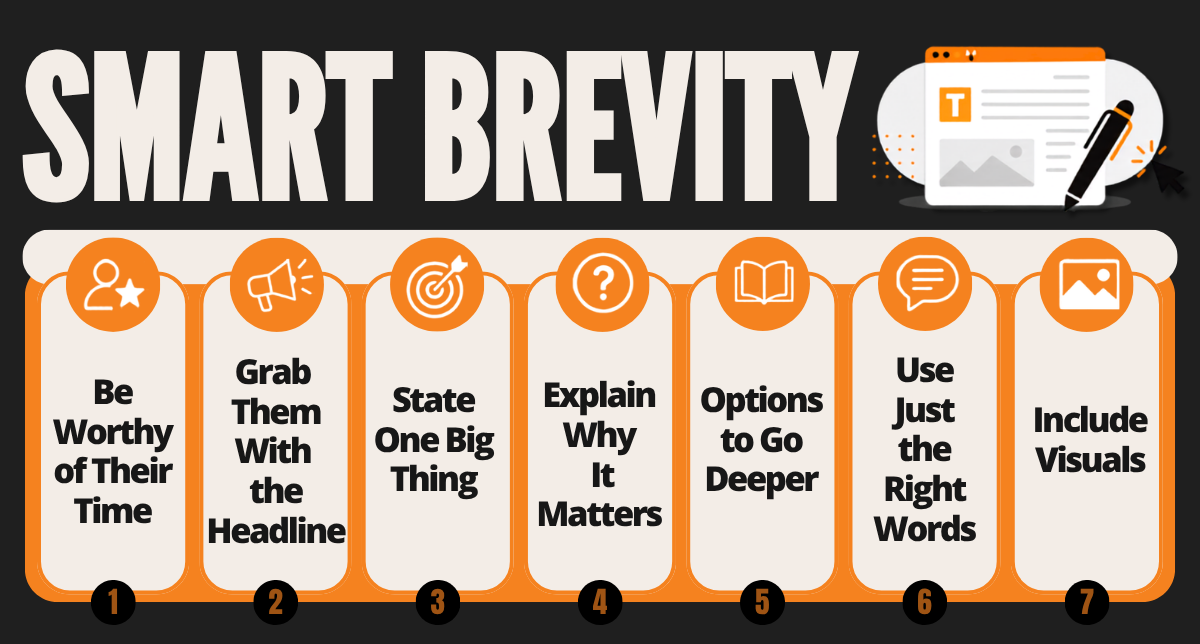
What Smart Brevity Looks Like
The framework is simple.
As shown in the graphic, effective communication often follows these seven principles:
- Be worthy of your reader's time.
- Grab attention with a meaningful headline.
- Focus on one primary message.
- Explain why it matters.
- Offer opportunities to learn more.
- Choose only the words that add value.
- Use visuals to support understanding.
None of these principles are new. Together, however, they make information easier to understand and easier to remember.
Why It Matters for your Business
Most businesses don't struggle because they have too little to say.
They struggle because they try to say everything at once.
- A website tries to explain every service on the homepage.
- A social media post contains six different messages.
- An email buries the important point halfway through the third paragraph.
The result is that readers stop reading.
People scan before they commit. If they can't quickly determine what's important, they'll often move on.
Smart Brevity removes that friction.
This idea complements many of the points we discussed in our article, Social Media Isn't Broken—Expectations Are. Clear, focused communication outperforms trying to say everything at once.

My experience
Over the years, I've worked with hundreds of professionals.
One mistake I see repeatedly is trying to fit everything into one marketing piece.
A brochure becomes overloaded with photos. A newsletter has multiple competing headlines. A social media post tries to announce a new service, promote an event, recognize an employee, and ask readers to get in touch—all at once.
The result?
Readers aren’t sure what their reading or why.
Effective communication starts with one objective. Make your primary message clear, then save the rest for another piece of content.
When everything is important, nothing stands out.
One message. One objective. One takeaway.
That's what people remember.
Smart Brevity doesn't mean oversimplifying
One common misconception is that shorter automatically means better.
It doesn't.
Some topics require explanation. Complex products, professional services, and strategic decisions all deserve thoughtful content.
The goal isn't to remove substance. It's to remove unnecessary words while keeping the ideas intact.
Good writing isn't measured by how few words you use.
It's measured by how clearly your audience understands your message.

Ask yourself this before you publish
Whether you're writing a LinkedIn post, updating your website, preparing a proposal, or sending a client email, Smart Brevity encourages you to ask one question before publishing:
"Am I making this easier for my audience to understand?"
If the answer is yes, you're far more likely to keep their attention.
And attention is the first step toward building trust.
At Lexabi, we believe effective communication isn't about saying more. It's about saying the right things, in the right order, in a way that's easy to understand.
Your digital presence should be easy to find and easily understood.
Every webpage, social media post, email, and other public communication helps shape the story people build about your business. Clear communication builds credibility, and credibility builds trust. Learn more about Digital Credibility Audits.
Frequently Asked Questions
What is Smart Brevity?
Smart Brevity is a writing approach that focuses on communicating ideas clearly and efficiently. It emphasizes short paragraphs, meaningful headlines, concise language, and delivering the most important information first while respecting the reader's time.
Does Smart Brevity mean writing fewer words?
Not necessarily. Smart Brevity isn't about making content as short as possible. It's about removing unnecessary words, organizing ideas clearly, and making information easier to understand without sacrificing meaning.
Where can businesses use Smart Brevity?
Smart Brevity works well across almost every form of business communication, including:
- Websites
- Social media posts
- Newsletters
- Email marketing
- LinkedIn articles
- Sales proposals
- Internal communications
Any content that needs to capture and hold attention can benefit from a clearer, more focused writing style.
How does Smart Brevity help build credibility?
When your message is clear, readers spend less time trying to figure out what you're saying and more time understanding your expertise. Clear communication reduces confusion, builds confidence, and supports the trust that influences buying decisions.